Showing posts with label UC faculty. Show all posts

21 November 2011

What Katehi didn't say

As we know the Davis Chancellor addressed the 5,000 participants at the rally held today on the UCD quad: the full 2:44 minutes of her emotional speech can be viewed here. She apologized for Friday's "events" and vowed to work to re-gain the students' trust. That cannot have been easy, and it certainly took courage. But equally important is what she did not say. For instance, here is something many were expecting to hear:
The Chancellor will ask the Yolo County DA to drop all charges agianst the arrested students.
This is so obvious it is a no brainer, and yet nothing was said in this respect. Here is another one:
The Chancellor will make sure that all riot control equipment on campus is removed from possession of UC PD.
Again, nothing in this direction. Or one more:
The Chancellor will make an explicit commitment to safeguard free speech and other constitutional rights on campus.
The list could go on, including working with the students to reverse tuition increases, working with faculty to restore shared governance, respect the right of workers and staff to unionize and engage in collective bargaining. But none of that was forthcoming today. Perhaps tomorrow?

13 October 2011

OWS

The Council of UC Faculty Associations endorses Occupy Wall Street, and asks people to sign a support petition:
The social movement known as Occupy <>Wall Street (OWS) is growing and raising issues of direct relevance to the faculty, students and staff of the University of California including contracting opportunities and increasing debt loads for our students created by a system of privatized education and a refusal to provide high quality affordable public higher education. TheCouncil of UC Faculty Associations, on behalf of all UC faculty, is making a petition supporting OWS available for UC faculty to sign.
 The petition is available here.

OWS has been variously criticized for their lack of clear objectives, but in fact it seems to me the opposite is true. Two young participants being interviewed the other day, from different parts of the country, when asked what is that they wanted, were adamantly clear: they wanted to find a job, buy a house, start a family, and pay down their student loans. 

These are middle class dreams, and it's remarkable that this aspect of the social compact that has been in place for a long time, has finally unraveled, with the financial crisis putting the final nail in the coffin. Maybe this time around the revolution is a dinner party.

The mention of student loans is also remarkable, and one of the most jarring consequences of the crisis. High levels of student debt might have been acceptable during the good times, when the prospects of finding a good job after college were reasonable (even this is debatable, as it presupposes that higher education is only a private good). But it is a real racket now, with lenders and universities (public, private and for-profit) equally addicted to the student-loan money, while the Feds are just watching and untold numbers of students are getting screwed. (Student loans cannot be dismissed, not even by a bankruptcy court; this is supposed to make lenders more willing to lend, and make more kids go to college, but the absence of such protection does not seem to make mortgages or car loans any more difficult. Go figure.)

Finally, one of the more colorful slogans from OWS: "I'll believe corporations are people when the State of Texas executes one of them."

23 September 2011

Where's MY senior manager?

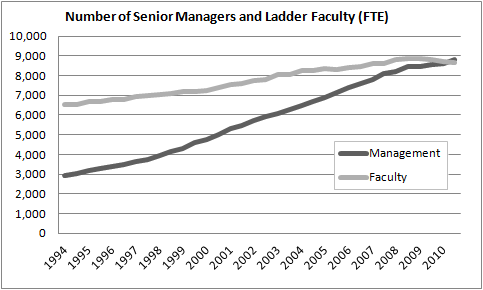
Back in 2009 Richard Evans pointed out that "soon every faculty member will have a personal senior manager," as the number of senior management FTE was fast approaching that of ladder rank faculty. Fast forward two years and, well, it happened: there are now 8,822 senior management FTE's at UC compared to 8,669 ladder-rank faculty FTE's. As Keep California's Promise puts it, "UC's administrators crossed the line:"


That's because thanks to budget cuts and hiring freezes, and according to UCOP's own data,  the faculty decreased by 2.3% since 2009, but the number of senior management FTE's increased by 4.2% in the same period (student enrollment also increased by 3.6% in the same period, and while the increased student-faculty ratio is problematic, the fact that more students are attending UC is, in itself, is a good thing).

21 September 2011

Negotiated Salary

For a long time, faculty in the Health Sciences have been receiving salary according to the aptly named  "Health Sciences Compensation Plan" (HSCP). HS faculty generate a sizable chunk of revenue for the University, and HSCP makes sure that they get some of it back in what the University calls a salary "augmentation." ("Augmentation" reminds one of a particular surgical procedure especially popular at, or around,  UCLA Medical Center. Go figure.)

There is nothing wrong with this, it is accepted and fair practice. HS faculty are collectively regarded as revenue generators and so they are all eligible for salary augmentation through HSPC. The University is now thinking of extending the concept to general campus faculty through a Negotiated Salary Program. In a memo detailing the proposal (link courtesy of UCLA Faculty Association), system-wide Vice Provost for Academic Personnel Susan Carlson outlines the motivation and some of the details of NSP.

NSP is intented to work pretty much like HSCP: faculty that generate external revenue would be able to negotiate some of that revenue back into a salary augmentation (typically paid, it would seem, as summer salary). Only funds that are not "state-appropriated" can be used for this purpose: "gifts and endowments, professional fees and fees in self-supporting programs, and [revenue from] contracts and grants" (the latter might run afoul of federal grant guidelines – we'll see).

Ostensibly the motivation for this is to address the notorious salary lag for CU faculty without resorting to "ad hoc state-funded off-scale salary increases in response to external offers" (fully two-thirds of all faculty now receive off-step salary) or to across-the-board increases in the salary scales. (The NSP program is not meant to supersede the University's recent commitment to a 3% salary increase or the 1.78% of payroll reserved for merits.) One aspect where NSP would differ from HSCP is that in the latter, as mentioned, all faculty are eligible, whereas in the former only small groups within a department, or perhaps only some departments within a school might be eligible, depending on the creation of "non-state-appropriated" revenue. As Carlson's memo points out,
A key factor driving the creation of the NSP is that on several UC campuses with Health Sciences schools, general campus faculty are considering appointments in the health sciences, often due to the flexibility of the salary benefits.
People can make up their own minds about UCOP's proposal. But one thing to keep in mind, though, is that there is an argument for carrying this to its logical conclusions: revenue is revenue, and funds that are state appropriated contribute equally to the functioning of the University. Among such funds, of course, is student tuition, which the University is bent on increasing in leaps and bounds. These are "private" funds – just ask the students out of whose pockets the money is extracted. One would then logically conclude that faculty that generate the most enrollment would also be allowed to retain some of the funds thus generated and pay themselves summer salary according to NSP guidelines. Money is money. Pecunia non olet. The English department faculty teaching writing to four hundred freshmen, doesn't she deserve her summer salary, too?

20 September 2011

No clue

It looks like nobody really has any clue as to how to go about addressing the University's financial problems. As widely reported, UCOP came up with a scheme whereby tuition would rise by 16% a year for the next four years (which compounds to 81%) unless the State steps in with yearly funding increases of 8% for the next four years. As anybody can imagine, this is not likely to engender warm and fuzzy feelings towards UC in those that are left as UC's only constituency and potential supporters, viz. the students and their families. Supposedly preoccupied by the fall-out, the Regents have swiftly acted with typical Regental drive and determination – and formed a commission with the task of exploring private donations as a source of external funding. The idea behind such a bold undertaking is that UC has traditionally contributed to the economic successes of California by supplying a steady stream of skilled and educated labor. California business ought to be willing to contribute to the University's bottom line in order to secure such a competitive advantage in the future as well. What this line of thought seems to have missed, though, is that there does not appear to be any reason why big business would be willing to pay in California for resources it can get for free in Mumbai – testifying yet again to the wisdom of Clark Kerr's vision characterizing a public supported education as "bait to be dangled in front of industry, with drawing power greater than low taxes or cheap labor." Perhaps even more disheartening is the fact that in all this the faculty and their official representation, the Senate, is mostly notable for their silence.  

01 September 2011

Meanwhile, in South Dakota ...

Well, it looks like South Dakota's Republican Governor Dennis Daugaard might have a bit of a problem on his hands when it comes to faculty salaries at the state's four universities, which have been frozen for the past three years:
Higher education officials tired of watching talented faculty jump to private industry and out-of-state universities for better pay want Gov. Dennis Daugaard to end South Dakota's salary drought. After three years of frozen wages, the Board of Regents says its priority in Daugaard's next budget is at least a 4 percent salary bump for all state workers. [...] State officials and Board of Regents members say they understand the toll that the wage freeze is exacting and intend to address it as best they can in the next legislative session. Daugaard's spokesman, Tony Venhuizen, said the governor is just beginning to formulate next year's budget, "and deciding on a salary policy number is an important part of that process."
  Perhaps there is a lesson here for the great state of California, too?

26 August 2011

The power of ten

Ever since the beginning of this blog, we predicted that the steady de-funding of UC by  the State, accelerated by the financial crisis, would have resulted in a serious strain on the system as a whole, and provided an incentive to follow the Michigan/Virginia model for those campuses that can (UCB and UCLA, essentially), while the remaining campuses would be left to fend for themselves.

Well, Cal has just announced that in spite of the most recent cuts, they are doing quite well, thank you, mostly because of the influx of out-of-state students (about one in three freshmen) and other "efficiencies" realized by following the prescriptions of the Bain report (the laying off of about 150 staff at Cal — it's easy to realize "efficiencies" this way, it's a lot harder to save money by allowing people to work to their fullest potential). 

In the meantime, UCOP has announced a program that would provide $140M to give non-represented staff and faculty a 3% pay raise. While the raise will be applied across the board, the the faculty component would only be available to faculty earning less than $200,000 a year (the vast majority of non-medical faculty) and it would be left to Chancellors to determine how best to apportion it for the purposes of "recruitment and retention." (The newly released report on 2010 compensation confirms that UC faculty salaries lag 12.8% behind those at comparable institutions.)

The proposal has generated a fair amount of criticism among the general public (Bruce Maiman is an example). Such criticism might be justified if UC still were the kind of public institution of higher learning that the State envisaged (and paid for) in the Master Plan. But in fact California has long ago decided that they are no longer willing to support an affordable, high-quality teaching and research institution open to all qualified Californians. The percentage of the UC budget paid for by the State has been shrinking for decades, and we are the point where only a fraction is taxpayers' money. A similar announcement by Stanford would not even make the news  — it's not public money. And, for better or for worse, this move by UCOP is also in large part financed through tuition money, just like it would be at a private institution.

Of course, the morality of raising tuition on the students to pay for faculty pay raises is questionable (retention of quality faculty at UC is in some sense a "public good" in that it benefits California in numerous ways). But California can't have it both ways: accept (or promote) de-funding the university while at the same time complaining about the way UC makes use of the money.

02 July 2011

Contingent faculty

As reported in the SF Chronicle, the Academic Council recommended last week that the University expand the use of contingent faculty "where appropriate" across the system, in the words of system-wide senate chair Dan Simmons. We have not seen any official announcement, or document such as meeting minutes to confirm this. But this would appear a major shift in the official position of the faculty: since when does the Senate recommend the expansion of non-senate faculty? It's enough that the administration has become addicted to the use of exploited, under-paid, and over-worked lecturers. It's a completely different position for the system-wide senate to come to the same conclusion. The senate should be in the business of expanding (at least some of) the benefits of the tenure system to contingent faculty – not sell our collective soul to satisfy the administration's appetite for a flexible workforce.

17 January 2011

UC faculty

At their January 19 meeting, the Regents will receive (and hopefully discuss) the biennial Report on Faculty Competitiveness.  It makes for very interesting reading, at a time when the University faces perhaps the most daunting challenges in its history, with the new Democratic Governor bent on disestablishing UC as a State-supported educational institution.

It's clear that the University stands or falls with the quality of its faculty. It's the faculty that teach the classes, carry out research, obtain the grants, perform public service, push innovation, etc. The document to be presented to the Regents has some telling data about UC faculty. Here are honors and awards earned by UC faculty
  • 56 Nobel Prizes
  • 7 Fields Medal (Mathematics) 
  • 60 National Medal of Science 16 
  • Pulitzer Prize 
  • 71 MacArthur Fellowship (“Genius Grant”)
 Even looking only at current faculty the record is equally impressive:
  • 377 members of the American Academy of Arts & Sciences
  • 650 members of the American Assoc. for the Advancement of Science 
  • 125 members of the Institute of Medicine 
  • 117 members of the  National Academy of Engineering 
  • 245 members of the National Academy of Sciences 
  • 56 faculty members of the Howard Hughes Medical Institute (HHMI)
Here is a breakdown of the composition of the UC faculty:
UC faculty have been getting older, reflecting the end of mandatory retirement in the 1990's, as well as continuing difficulties in recruitment:

At the same time, the increasingly old faculty are teaching more students, with less resources:

It is then not surprising that UC is feeling the heat of competition from the privates, who uniformly look to raid UC's most  prominent faculty. As the report puts it,
These fairly static demographics provide the context for present challenges in the recruitment and retention of UC faculty.  [...] At a time of reduced State support, growing enrollments, and a steady stream of faculty separating from the university, however, campuses are increasingly concerned about maintaining faculty quality.
And of course, faculty salaries continue to lag far behind (about 11.2%) those at peer institutions:

The report comments that "current lags are very likely higher because some of the comparators have continued annual pay increases. In addition, beginning April 2011, UC employees will have a portion of their salary redirected into the UC Retirement Program," yielding projected "lags  of six percent for Full Professors, nine percent for Associate Professors, and seven percent for Assistant Professors" (with 5% UCRP contrbutions).

UC has long prided itself for the faculty salary scales, which are supposed to encourage productivity; the scale are now meaningless as a full 65% of general campus faculty are now off-scale. The data on the salary lag above reflect actual salary; the official scales lag even further behind the comparison group (interesting tidbit for those of us receiving on-scale salary and suffering the effects of the "loyalty penalty").

It's no surprise that tenured faculty tend to leave UC, even if salary and benefits are structured to disincentivize such moves. And faculty move pretty much to the same set of high-quality institutions where they initially hired from: Stanford, NYU, USC, Columbia, Michigan etc. (see the document for a list, 640 in the last 10 years).

The report concludes that
To remain leaders in faculty recruitment and retention, UC will need to enhance salary and continue innovative approaches to designing faculty careers for the future.  There are clear warning signs that the University must be nimble in this work. [...] The University should plan to address both the needs of its long-serving, productive faculty and the expectations of its future faculty.  There are budgetary implications for improving faculty salaries and benefits, and for hiring new faculty at a rate that keeps pace with past and future enrollment growth and increasing faculty retirements, but these must be weighed against the costs of losing current faculty and of not being competitive for top recruits.

03 October 2010

Comparison-eight salaries

System-wide senate committees and working groups have started posting documents before they reach the stage of Council approval, which is a welcome development to the extent that it gives the rest of the faculty some insight into the workings of the system-wide senate and helps dispel the perception of senate proceedings as shrouded in mystery and removed from faculty concerns.

Among these documents is a report by the working group on Faculty Salaries and Total Remuneration, entitled "Faculty Salary Gap and Restoring UC Competitiveness." It makes for very interesting reading, at a time when UC seems poised to cut retirement benefits and increase employee contributions.

It's noteworthy that the proposed regime of fiscal austerity does not extend to upper echelons of the administration, witness the executive salary increases enacted by the Regents at their September meeting, bringing "executive salary increases and bonuses in fiscal year 2010 to an additional annual commitment of $11.5 million".

Equally  noteworthy is the stark contrast with faculty salaries. According to the working group report, faculty salaries lag significantly behind average salaries at the "comparison eight" institutions, a group which comprises four public universities (Illinois, Michigan, Virginia and SUNY Buffalo) and four private ones (Harvard, MIT, Stanford and Yale). Associate Professors seems to have it the worst: UC salaries lag behind comparison-eight averages by 13.3% for Full Professors, 15.2% for Associate Professors, and 9.2% for Assistant Professors.

These are average salaries, reflecting any off-step increments awarded to faculty (and we know there are units across the system where most faculty – like in Lake Wobegon – are above step). The administration has long argued that the salary lag disappears when considering total compensation, which includes benefits; but that was not true in the past, and it will certainly be even more of a fig leaf with the upcoming changes in the pension plan. 

The situation is even more disturbing when looking at the salary scales, which of course do not reflect off-step increases. Just to take an example from the report, the average salary for Full Professors at comparison-eight universities is $146,030; supposedly this should correspond to the mid-point through the Full Professor rank at UC. The on-step salary for Full Professors, step V  is $103,300 or almost a whopping 30% below the benchmark (and, yes, there actually are full professors in the system with on-step salaries). Clearly UC salary scales are totally meaningless.

In 2007 the Regents enacted a 4-year plan conceived (a) to close the gap with the comparison eight; and (b) to adjust the salary scales in order better to reflect real faculty salaries. The first year of the plan was implemented in 2007-08, but years 2-4 were promptly scrapped during the recession. In fact, faculty salaries, far from being adjusted upwards, were further reduced by the furlough program. 

The work group insists the a simple resumption of the 4-year plan would not be "tenable," and that a joint Senate-UCOP task force be appointed to further look into the situation. In the meantime, the following recommendations are put forward to the council for approval and transmittal to UCOP:
  1. UC budget proposals must provide for a resumption of the Faculty Salary Plan as of 2010-11;
  2. In recognition of resumed UCRP contributions, UC must enact an across-the-board increase of the salary scales of no less than 2%, also effective 2010-11;
  3. As soon as possible, the university must enact a further across-the-board increase of 5% applied to both salary and off-step increments, with further increments apportioned to actual salaries and salary scales as determined by the future task force.
These are all very real issues. Faculty do not have the protection afforded a large portion of the staff by the unions, which negotiate salary and benefits. The senate is our only voice, for now at least. Each division is represented on the Council by the divisional senate chair. Contact your representative on the council and urge swift and forceful action on the issue.

14 September 2010

The Bain Berkeley model for faculty: the sequel

First of all, here's why we should all care about what happens at Berkeley. The model being pushed at UCB by the administration on the basis of their Operational Excellence  initiative and the report commissioned from Bain is bound to be a benchmark for the whole system. The other nine campuses will be under increased pressure either to take similar measures or to be relegated to second-tier teaching institutions. It's important therefore that faculty and staff through the system respond to the more extreme distortions of the Berkeley-Bain model, on pain of seeing that model pushed on them as well.

We already commented on the two main components of the proposed model, i.e., the push to both centralize and standardize, and Chris Newfield now has a detailed analysis. In particular, Newfiled points out how the solutions proposed by the Bain report do not align with the problems they identify. Their diagnosis of the administrative problems at Berkeley should rather recommend a bottom-up, distributed organizational model (which is characteristic of organizations with a capacity to innovate), not the top-down, authoritarian model that Bain imported wholesale from  corporate culture – and an outdated one at that.

The most disturbing aspect of the report, of course, is the proposed staff reorganization based on the concept of supervisory span (the target here is a 6.6 span, meaning that each supervisor should have on average 6.6 position immediately below in the organizational chart). Moreover, the advertised 6% to 8% cut in their $700M payroll would translate in laying off close to 10% of the staff. Berkeley staff are understandably worried, especially in absence of any meaningful and organized response (see the comments to Michael Meranze's Staffing the Downsize).

Faculty should not be lulled in the conviction that the proposed reorganization does not affect them. It does and it will. If the recommendations of the Bain report are implemented, this would make life much more difficult for faculty as well (as also Chris Newfield points out). Let's not make any mistakes about this: until and unless the faculty speak up about this and support, even lead, the staff in their push-back, this what the future will look like at UCB and across the system.

But there is more: the Berkeley administration has, of course, a particular vision for the faculty as well (we would not expect anything less from them). It's just that it's easier to deal with staff first. The documents posted in preparation for the Aug 19 "Retreat" for Deans and Chairs spells it all out. A handout ominously entitled "Beyond Compromise" (written by two Berkeley faculty and an administrator) explains the implications of the Commission on the Future recommendations for Berkeley. Beside the by-now old chestnuts of online instruction and non-resident tuition, the presentation introduces "alternative faculty compensation plans." The handout does not go into much detail about these compensation plans, but it does indicate clearly that it would involve a "two-tiered status of faculty." The top tier supposedly would be comprised of research faculty (bringing in copious amounts of grant money under increased overhead rates), while the bottom tier would be comprised of mainly teaching faculty, including a "greater proportion of courses to be taught be lecturers and GSIs." The proposed shift would naturally result in "fewer ladder rank faculty, more lecturers."

Not a lot of reflection is needed to see just how bad an idea this is. The two-tiered model for faculty runs counter to very idea of a research institutions and undermines shared governance. The whole point a student coming to Berkeley is the opportunity to be taught by world-class faculty and, for instance, learn physics from a Nobel laureate. Conversely, our top faculty should relish the opportunity to teach introductory-level courses. Expanding the roles of lecturers and GSIs would greatly damage the idea of an institution such as Berkeley. Graduate students are not here to provide cheap labor but to learn the trade and develop their research skills.

One also has to wonder how exactly Berkeley plans to reduce the ratio of ladder faculty to lecturers and GSIs. Attrition through a hiring freeze? Tightening tenure standards? Encouraging people to leave by not matching outside offers?

Again, if the faculty at Berkeley and elsewhere do not speak up and develop an articulated response to these guidelines, this is what the future will look like.

30 March 2010

UC faculty salaries

A couple of interesting data points coming out of UCOP shed some light on where UC faculty salaries stand with respect to the "Comparison Eight" institutions. The Comparison Eight are four private and four public institutions that are used by UC to compare faculty salary scales and student fees. The four public universities are Illinois, Michicgan, Virginia and SUNY Buffalo; the four privates are Harvard, MIT, Stanford and Yale.

So, how does UC compare with peer institutions? The first slide shows that the last time UC salaries (general campus averages, not professional or medical schools) were in line with the the Comparison Eight average was in 1999-2000. That's when the peak of the dot-com boom occurred, Al Gore was running for president and Lieberman was still a democrat:

By 2009-2010 the average of the four private peers was out of sight, and UC was only slightly above the average of the four public peers, in spite of most of the faculty living in some of the most expensive real estate markets in the country.

As is well known, in 2006-07, the university implemented a plan to bring UC salaries back to market level by, well, next year. The first part of the 4-year plan was implemented in  2006-07, by we know what happened next:

UC salaries are now less than 90% than the market level, with no talk of resuming the 2006 plan.

25 March 2010

Skimming the UCOF proposals

As widely reported, the proposals contained in the preliminary report of the UC Commission on the Future, are numerous and varied.  Here are a few highlights, beginning with the good parts.
  • Continue the University's commitment to the Top 1/8, which promises the top 12.5% of high school graduates in California admission to a UC campus.
  • Continued commitment to financial aid for low-income students.
  • Increased graduate enrollment, to bring in line with the proportion of graduate students to undergraduates at peer research institutions.
  • Establish financial aid eligibility for undocumented students.
  • Give students a multi-year tuition (the standard term to replace "fee") schedule, so as to avoid mid-year increases like the one from last November.
All of these are laudable and clear goals, but none of the above address the financial situation of the university. When it comes to pointing to a possible solution to the current budget crisis, the Commission's recommendations are often vague, outlandish, controversial, or all of the above:
  • Increased enrollment of non-resident students, ranging from 5% to 15% of total enrollment, possibly displacing California students. 
  • Increase the newly-christened tuition by 5%, 10%, or 10% or  (according to different scenarios) a year for five years, bringing tuition to $13,148, $16,591, or $20,721 by 1015-16, respectively.
  • Introduction of 3-year degrees by streamlining requirements and expansion of summer session courses and AP credit transfers.
  • Exploration of online courses, the holy grail of financially challenged institutions.
  • Revision and renegotiation of Indirect Cost Recovery (IRC) formulas, based on the principle that externally supported research must include 100% of indirect costs.
  • Expansion of self-supporting programs, e.g., Executive MBA's.
  • Allow externally supported researchers to buy out their teaching from their grants, and hiring non-ladder faculty to "backfill" those researchers' vacated teaching.
  • Explore the possibility of allowing different campuses to set different tuition levels.
  • Promote a set of administrative "best practices" to eliminate administrative redundancies and bring about efficiencies at all levels. 
What is most striking about these proposal is how vague they are. The last point, concerning "administrative best practices," for instance, is just an empty slogan unless substantiated by clear examples and precise criteria of applicability. Other proposals are bound to be controversial with the faculty: implemementing 3-year degrees would require strictly holding faculty and departments to pre-set teaching load (a number being circulated is 900 credit hours a year for each faculty member). Similarly, insisting on 100% indirect cost recovery will not ingratiate the science faculty at all.

The proposal that perhaps most endangers the UC system as it was originally conceived is the possibility of setting differential tuition by campus. This would mean that Berkeley and Los Angeles would be able to charge private-level tuition, while reduced funding at the remaining eight campuses would gradually turn them into state schools. It would be, for all practical purposes, the end of the UC system.

The Commission's report contains a couple of significant acknowledgments, though. The first is the recognition that with less than 100% ICR, research has to be subsidized by core funds. While this might have some rational during the good times, it is less justifiable now. The other one recognizes that given the disparity among disciplines in their access to external sources, internal funding has to be prioritized towards disciplines in the arts, humanities, and social sciences.

The report fails to endorse an oil severance tax targeted for higher-ed funding, the way it is used, for instance, in Texas. Instead, the report goes into some discussion of a general tax for higher education, which would be even more politically unfeasible than oil severance.

But the most basic and longest-lasting impression that one receives upon reading the report, is that it is a document which fundamentally lacks an overarching vision for the university. It's a report that puts together a number of local ideas, some of which have been circulating for years, hoping that their cumulative effect would lead the university out of the crisis. There is no reason to think so. The recommendations are vague, politically controversial, and occasionally contradictory.

Only the articulation of a comprehensive plan, guided by some clear and fundamental principles, would have a chance of bringing together the different constituencies in the university. The way the recommendations are formulated right now, they will only pit students against administrators, science faculty against humanities faculty, and top-tier campuses against the lower-tier ones.

02 March 2010

March 4

March 4 is only a couple of days away, and a number of events are scheduled around the state, including a rally on the Capitol steps. The administration has mounted a sizable effort to redirect the protests away from Oakland towards Sacramento, and certainly the dysfunctional Legislature and ineffective Governor bear much of the fault for the current state of the University. But it is also clear that, under the heading "never let a good crisis go to waste," UCOP is looking to use the current situation to push through momentous changes in the way the University is funded and run, from a shift to a "public/private" model to an attack on faculty governance (a weak senate leadership being complicit in this effort).

Will it work? Much depends on participation on the various campuses, especially when it comes to faculty that until now have preferred to sit on the sidelines.

10 February 2010

Faculty statement in support of March 4 action

The future of the University of California, and public education in California more generally, is under extreme threat. Governor Schwarzenegger and the State Legislature have slashed funding, and the UC Regents, Office of the President, and campus administrations have responded with measures that undermine the core teaching, research, and service mission of the university: student fees have been raised dramatically, hiring has been frozen, faculty and staff have been furloughed, lecturers have been fired, and many staff positions have been consolidated or eliminated, even as salaries of the highest UC executives have been increased. Market standards have superseded the values of intellectual creativity and excellence. Next year’s planned cuts will only accelerate these trends. The defunding of public higher education makes a college education inaccessible to many Californians, especially those already most disadvantaged; it endangers the vibrancy and livelihood of the state; it lowers the quality of life of all of its inhabitants.

The Governor acknowledged that student and faculty protests have affected him. The time for more pressure is now.

We continue the fight for public education in California. On March 1, UC faculty, staff, and students will lobby the Governor and legislators in Sacramento. Then, the struggle for public education ramps up on March 4, a day of system- and state-wide actions called by students, staff, and faculty from the ten UC campuses, the Cal State University system, the Community Colleges, and K-12 schools. That day, there will be a march on Sacramento and other actions in the state capital, as well as actions on local campuses and elsewhere, to demand the restoration of high quality public education that is accessible and affordable to all. We, the undersigned UC faculty, will suspend “business as usual” and participate in the March 4th day of actions for public education.

UC faculty can add their name to the letter by pointing their browsers to http://checkingeducation.com/faculty-statement.

20 January 2010

$3.1M in incentive pay at UCMCs

During their their meeting this week in San Francisco, the Regents are expected to approve $3.1M in incentive pay for 38 senior medical center managers. That's an average of $81,600 for each manager, with David Feinberg, head of UCLA's Medical Center, earning close to $220,000 in incentive pay alone.
UCSF Chancellor Susan Desmond-Hellmann said her hospital saw a more than 5 percent drop in one type of infection, and that 89.5 percent of patients surveyed reported being satisfied with care. "This is how you run a great medical center," she said, referring to incentives.
The $3.1M do not come from state funds, but from medical center profits. According to the SF Chonicle,  the University would likely be sued if they did not approve the incentive pay (as such incentives were in the managers' appointment letters).

This raises a couple of questions:
  1. The MCs are turning out millions in profits, should they not be asked to help support the University at large, the same way in which the University at large supports them?
  2. There are many faculty and perhaps staff whose salary is specified in their letters of appointment or promotion. Why does the furlough program not expose the University to potential lawsuits from these faculty and staff?
  3. And, since we are at it, why not extend the incentive program across the board? Here is a deal: if 89.5% of my students are satisfied with my teaching and I increase their test scores by 5%, I propose that the University  award me the average incentive of $81,600.

27 October 2009

Student coalition calls for system-wide strike

A student coalition is calling for a system-wide strike to be held Nov.18-20, concomitantly with the Regents' meeting where the proposed fee increases for next year will be considered.

The students demand:
  • that the Regents vote no on the proposed fee increases.
  • that the UC stop cuts and layoffs, and end its aggressive union-busting tactics.
  • transparency of the UC budget, including complete figures on how much of the additional revenue from fees will be diverted for construction and used as bond collateral.
  • that the Regents expand enrollment of underrepresented groups and ensure equal access to education for all.
  • an explanation for the failure of the UC leadership to make an effective case for public higher education.
These seem all pretty much on track to me.

12 October 2009

All hat and no cattle

If one needed any  proof that Gov. Schwarzenegger's emphasis on transparency and accountability is just for show, one would have to look no further than the Governor's veto of  S.B. 86, S.B 218 and S.B 219.

S.B 86 would have imposed limits on executive compensation at CSU and UC; S.B. 218 would amended the California Public Records Act to include organizations performing auxiliary functions for CSU and UC; and S.B. 219 would have extended whistleblower protection to UC employees. All three bills were introduced by Sen. Leland Yee, and approved by the Legislature. All three were opposed by senior management at UC and CSU.

We had already commented on Sen. Lee's laudable efforts. It does look like Sen. Lee and Lt. Governor Garamendi are the only ones left in California public life who have any sense at all.

Schwarzenegger defended his veto of executive compensation caps by claiming that
A blanket prohibition limiting the flexibility for the UC and CSU to compete, both nationally and internationally, in attracting and retaining high level personnel does a disservice to those students seeking the kind of quality education that our higher education segments offer.
But even if we agreed with the Governor's (and UCOP's) privatization strategy, this seems backwards: if it wanted to guarantee students the best education experience California has to offer, the University should be actively recruiting and appropriately compensating its faculty, not the administrators. Let me ask you: When's the last time you heard of universities and colleges being ranked by the quality of their administrators? I can imagine it already, US News and World Report advising students to attend such and such a school — they have lousy teachers and no facilities, but their administrators rock!


The other lesson we learn from this (besides the fact the Governator talks the talk but does not have the balls to walk the walk), is that UC's (and CSU's) lobbying efforts paid off handsomely, at least for senior management at UCOP and across the campuses. The lobbyists UC employs (at an annual cost of $1.6M in payroll only) obviously managed to get the Governor's ear, convincing him to overturn the decision of elected officials in the California legislature.

17 September 2009

Yudof's address to the Regents

The UC Regents met yesterday, Sept. 16, to discuss the proposed increase in fees for undergraduate students at the University. After a bit of bru-ha-ha, the meeting could get down to business, beginning with Yudof's address to the Regents (the videos can be found here, here and here).

This was a passionate plea by Yudof to the Regents, and again one that is worth a close look for the information it provides on the direction where the University is headed. Yudof began by painting a rather bleak picture: the worst is far from over, the state budget will not improve next year, federal stimulus money will go away, all the while the university has to deal with an "unreliable partner," viz., a "dysfunctional state government."

Having thus described the situation, Yudof then proceeded to articulate his argument, whose first premise is that we shold give up "faith-based budgeting," i.e., coping with the present situation hoping that things will get better. Things will not get better, the State will not provide more money for the University (for a number of complex but well known reasons). We have to face the "unhappy truths;" we can, and should go to Sacramento for more money, but we should be aware that the State has no more money to give.

The second premise of Yudof's argument is that "mediocrity is the greatest enemy of the UC." We must do everything we can to preserve quality. From these two premises it follows that we must increase our reliance on the only other source of revenue that is available to the University, and increase student fees. Students must realize that the State "stopped building freeways to higher education" and is now "building toll-roads."

This is the main argument. Are there alternative solutions? Yudof does not think so: he denied that there were administrative raises, denied that there were "unrestricted" or "reserve" funds in the budget (and even if there were, say at the Medical Centers — and he's not saying there are —it would "wrong" and perhaps "illegal" to use them), blamed the union's (and especially AFSCME's) unwillingness to negotiate for the layoffs.

The fee increases are necassary, according to Yudof, in order to "stop the decline of the academic program" at the University, prevent a brain drain at the UC, and "do away with the furloughs" as of next summer (a connection that has the added benefit. obviously, to divide the faculty and the students).

Pres. Yudof ended reminding the Regents of the Blue and Gold Program, allowing any student whose family earns less than $60K to attend UC for free, the fact that 30% of the increase returns to aid, and the very high proportion of student on Pell Grants, the highest of any research university.

Yudof's vision is clear and, if we accept the two main premises of his argument, his plan is rational and compelling. The details of his plan have, of course, been poorly executed, but that is a different story. The Pitts memos, for instance, were blunders of historic proportions: if UCOP had received the Senate's recommendations we would not probably be here considering an unprecedented faculty walkout on the first day of classes, and in fact nobody would be surprised if Larry Pitts were at some point scapegoated for this. The administrative raises, that were (contrary to Yudof's claims) real and documented, were very bad optics, even if inconsequential in the $20B budget of the University. And the decision to protect the revenue-generating units at UC, first and foremost the five Medical Centers, even it meant gutting the core campuses, could have probably been avoided or mitigated. But these are matters that concerns the implementation of plan, not the plan itself.

Yudof has been criticized as a "privitazer," but his views is not to turn UC into a private university, but into a true hybrid institution. As pointed out elsewhere on this blog, there are reasons to think that that goal might not be attainable, as hybrid istitutions are inherently unstable, but that is Yudof's vision. We can either accept that vision or reject at least one of Yudof's premises. Since preservation of quality at UC is a goal that we share, the only option on the table is to engage in political action to make sure that the State's priorities are reversed and its funding model radically altered. Not easy, but is there another way?

16 September 2009

The hybrid model

As previously pointed out, with the new increases now being proposed to the Regents, student fees will soon be the single largest source of revenue for the University. This means that, for all practical purposes, the University of California is now officially a "hybrid" university, i.e., an institution that, as indicated (and in fact advocated) by Pres. Yudof already in 2002, combines aspects of both public and private universities. 

It is therefore not too early to try to assess how successful the hybrid model appears to be. Well, we know where we are: faculty and staff are subject to furloughs (which for many are straight-out salary reductions), students are being hit with mid-year fee increases, unit 18 lecturers are being laid off, programs are being cut if not eliminated altogether, and all this while revenue-generating units at UC rather than being asked to help support the core mission of the University are largely spared (through furlough exchange programs or other gimmicks). 

As it is becoming increasingly clear, the hybrid model is inherently unstable, and in fact there appears to be a "tipping point" that we have already reached: once most of the revenue for the University is obtained through student fees, a UC education becomes a private good, subject to market pressure and increasingly accordingly priced. The State then has fewer and fewer incentives to support higher education in California the way it originally did in virtue of its social fallout. At the same time, more and more students are priced out of a UC education, further eroding public support for UC. The result will be even  lower State appropriations, which will lead to even higher fees, reinforcing the cycle.

With fees over $10,000 the total cost a family has to shoulder to send a student to the University of California is around $25,000 a year. It's true, as has been pointed out, that this is still a bargain compared to the privates, but we are already within sight of the cost of tuition at least at some privates. For that amount of money, students will expect an education experience that is not too dissimilar from that which can be obtained at a private institution: smaller classes, better facilities, etc. Hence an incentive to even steeper fee increases, which will lead to diminished State support.

The conclusion seems to be that there is no such thing as a hybrid university, at least not for very long.

Once we reach the tipping point (and we can discuss exactly where that is located), the pressure mounts for a full-blown privatization of those bits and pieces of the university that already look like a private institution. Since different campuses can undergo this process at different rates, this might well eventually lead to the break up of the University. Already, and perhaps understandably, Berkeley is  doing all it can to mitigate the consequences of the budget crisis through a number of measures, at the same time looking for ways to pay for them (e.g., through increased out-of-state enrollment, which of course will lead to fewer State resources, reinforcing the privatization cycle).

It is quite possible that privatization is inevitable, and the model of the University of California as set out in the Master Plan is doomed. But it would have been nice to get here through some sort of public debate among the consitituencies of the University (students, their families, the faculty and staff, as well as UCOP, the Regents and the State). Instead, this process is being implemented form above, under the guise of adjusting to a "middle point" — the hybrid model — which cannot be an equilibrium for very long.