19 November 2011
UC Davis' "vision of excellence"
It seems like UC Davis Chancellor Linda Katehi finally succeeded in her stated goal to obtain much deserved national recognition for her campus.

17 November 2011
The dirty secret behind UC privatization
There is much to think about in Nathan Brown's remarks, delivered at the Tuesday day of protest, even if one does not agree with everything he says. In particular, his claim that in many ways UC likes to replace state funds with student tuition, seems right on the mark. State funds are restricted, and they can mostly be used for instructional purposes. Student tuition is unrestricted, and it can be used, for instance, as collateral for bonds intended to finance capital projects (a point Bob Meister has been making for quite some time).
15 November 2011
Regents' retreat
Only for the fourth time in history, the UC Board of Regents has cancelled a meeting, apparently out of concern that protests planned concomitantly with the meeting might turn violent. Oh, c'mon, really? I am sure a few baton pokes from UC PD officers would have sufficed in keeping the distance between the ragged and smelly students and the highest officers of the University.
03 November 2011
New Budget Model
UC Davis has released a white paper outlining a proposal for a "new budget model" (we had discussed something similar back in February). The proposal is in line with, but independent of, the "Funding Streams" model being implemented by UCOP, and similar to the corresponding allocation schemes at Michigan or Minnesota. The leading idea of Funding Streams is that revenue is to remain with the campuses that generate it (hence, for instance, Berkeley's push to enroll more out of state and international students). The Davis proposal brings this idea down to the different units on campus ( a "unit" is defined, for the purposes of the white paper, as anything headed by a Dean, or the equivalent of such). Revenue generated at UC Davis — i.e., student tuition and indirect cost recovery from grants —would be allocated to the units proportionally to the amount of student tuition and grant dollars generated. The central campus would then assess a "tax" on such revenue (including return to aid) supposedly in proportion to resources each unit is using.
This is the main idea. The details are worth a look, too. First of all, "student tuition" means blended tuition, i.e., a campus-wide average of in-state and out-of-state tuition. This way, although the campus has a strong incentive to recruit out-of-state students, no single unit does. Second, part of the moneys recovered through the assessment would go (besides support for shared resources, such as the central library etc.) to fund a "Provost Supplement" allocated centrally to the units in order to further the campus' strategic goals. Finally, it's noteworthy that there is no presupposition that the Deans will, in turn, allocate resources within their own units according to anything resembling the same principle. So although cross-unit subsidies would (presumably) be curtailed, departments within each unit would still be jockeying for increased resources. The proposal also addresses the issue of how a student's tuition is to be shared between the unit teaching the class and the unit hosting the student's major (answer: 65% to 35%).
The proposal is to be praised to the extent that it brings a measure of transparency to an otherwise totally mysterious process. It is also, to an extent, a transfer of power from central administration to the Deans, for better of for worse. But it does nothing, by itself, to address budgetary shortfalls: while units in the sciences are motivated to increase the number and size of their grants (although grants are, as finally acknowledged, a net loss to the university), the number of student credit hours is more or less fixed, certainly in the short term. So the units, especially the ones that rely on teaching vast numbers of undergraduates, would essentially be engaging in a zero-sum game.
It remains to be seen whether the proposal, strongly advocated by Chancellor Katehi, will be favorably received at UCOP (probably yes) and on the other campuses across the system.
This is the main idea. The details are worth a look, too. First of all, "student tuition" means blended tuition, i.e., a campus-wide average of in-state and out-of-state tuition. This way, although the campus has a strong incentive to recruit out-of-state students, no single unit does. Second, part of the moneys recovered through the assessment would go (besides support for shared resources, such as the central library etc.) to fund a "Provost Supplement" allocated centrally to the units in order to further the campus' strategic goals. Finally, it's noteworthy that there is no presupposition that the Deans will, in turn, allocate resources within their own units according to anything resembling the same principle. So although cross-unit subsidies would (presumably) be curtailed, departments within each unit would still be jockeying for increased resources. The proposal also addresses the issue of how a student's tuition is to be shared between the unit teaching the class and the unit hosting the student's major (answer: 65% to 35%).
The proposal is to be praised to the extent that it brings a measure of transparency to an otherwise totally mysterious process. It is also, to an extent, a transfer of power from central administration to the Deans, for better of for worse. But it does nothing, by itself, to address budgetary shortfalls: while units in the sciences are motivated to increase the number and size of their grants (although grants are, as finally acknowledged, a net loss to the university), the number of student credit hours is more or less fixed, certainly in the short term. So the units, especially the ones that rely on teaching vast numbers of undergraduates, would essentially be engaging in a zero-sum game.
It remains to be seen whether the proposal, strongly advocated by Chancellor Katehi, will be favorably received at UCOP (probably yes) and on the other campuses across the system.
25 October 2011
13 October 2011
OWS
The Council of UC Faculty Associations endorses Occupy Wall Street, and asks people to sign a support petition:
OWS has been variously criticized for their lack of clear objectives, but in fact it seems to me the opposite is true. Two young participants being interviewed the other day, from different parts of the country, when asked what is that they wanted, were adamantly clear: they wanted to find a job, buy a house, start a family, and pay down their student loans.
These are middle class dreams, and it's remarkable that this aspect of the social compact that has been in place for a long time, has finally unraveled, with the financial crisis putting the final nail in the coffin. Maybe this time around the revolution is a dinner party.
The mention of student loans is also remarkable, and one of the most jarring consequences of the crisis. High levels of student debt might have been acceptable during the good times, when the prospects of finding a good job after college were reasonable (even this is debatable, as it presupposes that higher education is only a private good). But it is a real racket now, with lenders and universities (public, private and for-profit) equally addicted to the student-loan money, while the Feds are just watching and untold numbers of students are getting screwed. (Student loans cannot be dismissed, not even by a bankruptcy court; this is supposed to make lenders more willing to lend, and make more kids go to college, but the absence of such protection does not seem to make mortgages or car loans any more difficult. Go figure.)
Finally, one of the more colorful slogans from OWS: "I'll believe corporations are people when the State of Texas executes one of them."
The social movement known as Occupy <>Wall Street (OWS) is growing and raising issues of direct relevance to the faculty, students and staff of the University of California including contracting opportunities and increasing debt loads for our students created by a system of privatized education and a refusal to provide high quality affordable public higher education. TheCouncil of UC Faculty Associations, on behalf of all UC faculty, is making a petition supporting OWS available for UC faculty to sign.The petition is available here.
OWS has been variously criticized for their lack of clear objectives, but in fact it seems to me the opposite is true. Two young participants being interviewed the other day, from different parts of the country, when asked what is that they wanted, were adamantly clear: they wanted to find a job, buy a house, start a family, and pay down their student loans.
These are middle class dreams, and it's remarkable that this aspect of the social compact that has been in place for a long time, has finally unraveled, with the financial crisis putting the final nail in the coffin. Maybe this time around the revolution is a dinner party.
The mention of student loans is also remarkable, and one of the most jarring consequences of the crisis. High levels of student debt might have been acceptable during the good times, when the prospects of finding a good job after college were reasonable (even this is debatable, as it presupposes that higher education is only a private good). But it is a real racket now, with lenders and universities (public, private and for-profit) equally addicted to the student-loan money, while the Feds are just watching and untold numbers of students are getting screwed. (Student loans cannot be dismissed, not even by a bankruptcy court; this is supposed to make lenders more willing to lend, and make more kids go to college, but the absence of such protection does not seem to make mortgages or car loans any more difficult. Go figure.)
Finally, one of the more colorful slogans from OWS: "I'll believe corporations are people when the State of Texas executes one of them."
23 September 2011
Where's MY senior manager?
Back in 2009 Richard Evans pointed out that "soon every faculty member will have a personal senior manager," as the number of senior management FTE was fast approaching that of ladder rank faculty. Fast forward two years and, well, it happened: there are now 8,822 senior management FTE's at UC compared to 8,669 ladder-rank faculty FTE's. As Keep California's Promise puts it, "UC's administrators crossed the line:"
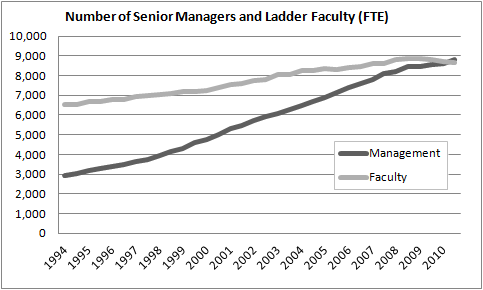
That's because thanks to budget cuts and hiring freezes, and according to UCOP's own data, the faculty decreased by 2.3% since 2009, but the number of senior management FTE's increased by 4.2% in the same period (student enrollment also increased by 3.6% in the same period, and while the increased student-faculty ratio is problematic, the fact that more students are attending UC is, in itself, is a good thing).
That's because thanks to budget cuts and hiring freezes, and according to UCOP's own data, the faculty decreased by 2.3% since 2009, but the number of senior management FTE's increased by 4.2% in the same period (student enrollment also increased by 3.6% in the same period, and while the increased student-faculty ratio is problematic, the fact that more students are attending UC is, in itself, is a good thing).
Subscribe to:
Posts (Atom)