Showing posts with label UC budget. Show all posts
Showing posts with label UC budget. Show all posts
28 April 2012

09 April 2012
UC decline
UCOP's recent memo to the Regents outlines the effects of years of ruthless cutting at the University of California (thanks to Bob Samuels for the pointer):
- At UC Riverside, [students] will walk onto a campus where enrollment has grown in the last three years by nearly 3,000 students – many of them the first in their families ever to attend college – while at the same time the number of faculty has been reduced by five percent. The result: class sizes have grown by 33 percent. Introductory physics classes that used to average 95 students have exploded in size in three years to 573 students.
- At UC Davis, students will find an acclaimed medical center that has eliminated all State supplemental support for clinical care. Just as the campus’ athletic program had begun to mature, four sports had to be eliminated to help meet the need to make $106.5 million in cuts in four years.
- At UC Santa Cruz, students will be provided with 84 fewer course offerings and their class sizes will have spiked 33 percent. The student-faculty ratio has exploded by nearly 15 percent, and the campus lacks funding for 125 faculty FTE – 14 percent of its faculty positions. Yet for all the cuts, the campus still faces a daunting $38 million budget gap.
- UC Santa Barbara has over 1,000 more students than it did three years ago, but the number of staff has declined by 450 (nearly 11 percent) during that time, and the faculty has remained the same size. The results are fewer student services, larger classes and discussion sections, and reductions and eliminations in many programs.
- And across the system, pension costs alone will rise to $1.8 billion annually in the next five years – an expense that campuses did not have to shoulder as recently as three years ago. If there is no increase in either State funds or tuition during this time, campuses will have to find the equivalent of funding for 7,000 staff or 3,900 faculty to fund this expense alone.
- At UC Berkeley, despite its more mature capacity to raise private funds and attract non- resident students, the campus forecasts that – even with stable fee increases – it could face at least a $200 million budget gap within six years due to exploding pension contribution costs.
Similar conditions exist on every other UC campus – from UCLA and San Diego to Merced,
Irvine and Santa Barbara. The University faces an unprecedented threat to academic quality. While this is a welcome change from the fiction that the University can absorb whatever cuts the state throws at it, the memo engages in some measure of wishful thinking when outlining possible solutions to the current dire situation, from increased indirect cost recovery to private philanthropy.
Perhaps the most promising avenue is the multi-year funding agreement with the state included in the Governor's latest budget. But the agreement is contingent on voters' approval of the Governor's "revenue-enhancing initiative" this fall, failure of which would result in another $200M mid-year cut.
24 December 2011
Social Security Deduction
It would seem that the University was not prepared for the extension of the
Social Security tax cut just approved by Congress. As a result, January
paychecks will reflect the old, higher payroll tax rate of 6.2% instead of
the 4.2% that's been in place throughout 2011. The extra amount withheld
will appear instead on the next paycheck, on Feb 1 for most employees.
So our Jan 1 paychecks will be 2% lower than our Dec 1 paychecks. Happy 2012 to all!
So our Jan 1 paychecks will be 2% lower than our Dec 1 paychecks. Happy 2012 to all!
17 November 2011
The dirty secret behind UC privatization
There is much to think about in Nathan Brown's remarks, delivered at the Tuesday day of protest, even if one does not agree with everything he says. In particular, his claim that in many ways UC likes to replace state funds with student tuition, seems right on the mark. State funds are restricted, and they can mostly be used for instructional purposes. Student tuition is unrestricted, and it can be used, for instance, as collateral for bonds intended to finance capital projects (a point Bob Meister has been making for quite some time).
03 November 2011
New Budget Model
UC Davis has released a white paper outlining a proposal for a "new budget model" (we had discussed something similar back in February). The proposal is in line with, but independent of, the "Funding Streams" model being implemented by UCOP, and similar to the corresponding allocation schemes at Michigan or Minnesota. The leading idea of Funding Streams is that revenue is to remain with the campuses that generate it (hence, for instance, Berkeley's push to enroll more out of state and international students). The Davis proposal brings this idea down to the different units on campus ( a "unit" is defined, for the purposes of the white paper, as anything headed by a Dean, or the equivalent of such). Revenue generated at UC Davis — i.e., student tuition and indirect cost recovery from grants —would be allocated to the units proportionally to the amount of student tuition and grant dollars generated. The central campus would then assess a "tax" on such revenue (including return to aid) supposedly in proportion to resources each unit is using.
This is the main idea. The details are worth a look, too. First of all, "student tuition" means blended tuition, i.e., a campus-wide average of in-state and out-of-state tuition. This way, although the campus has a strong incentive to recruit out-of-state students, no single unit does. Second, part of the moneys recovered through the assessment would go (besides support for shared resources, such as the central library etc.) to fund a "Provost Supplement" allocated centrally to the units in order to further the campus' strategic goals. Finally, it's noteworthy that there is no presupposition that the Deans will, in turn, allocate resources within their own units according to anything resembling the same principle. So although cross-unit subsidies would (presumably) be curtailed, departments within each unit would still be jockeying for increased resources. The proposal also addresses the issue of how a student's tuition is to be shared between the unit teaching the class and the unit hosting the student's major (answer: 65% to 35%).
The proposal is to be praised to the extent that it brings a measure of transparency to an otherwise totally mysterious process. It is also, to an extent, a transfer of power from central administration to the Deans, for better of for worse. But it does nothing, by itself, to address budgetary shortfalls: while units in the sciences are motivated to increase the number and size of their grants (although grants are, as finally acknowledged, a net loss to the university), the number of student credit hours is more or less fixed, certainly in the short term. So the units, especially the ones that rely on teaching vast numbers of undergraduates, would essentially be engaging in a zero-sum game.
It remains to be seen whether the proposal, strongly advocated by Chancellor Katehi, will be favorably received at UCOP (probably yes) and on the other campuses across the system.
This is the main idea. The details are worth a look, too. First of all, "student tuition" means blended tuition, i.e., a campus-wide average of in-state and out-of-state tuition. This way, although the campus has a strong incentive to recruit out-of-state students, no single unit does. Second, part of the moneys recovered through the assessment would go (besides support for shared resources, such as the central library etc.) to fund a "Provost Supplement" allocated centrally to the units in order to further the campus' strategic goals. Finally, it's noteworthy that there is no presupposition that the Deans will, in turn, allocate resources within their own units according to anything resembling the same principle. So although cross-unit subsidies would (presumably) be curtailed, departments within each unit would still be jockeying for increased resources. The proposal also addresses the issue of how a student's tuition is to be shared between the unit teaching the class and the unit hosting the student's major (answer: 65% to 35%).
The proposal is to be praised to the extent that it brings a measure of transparency to an otherwise totally mysterious process. It is also, to an extent, a transfer of power from central administration to the Deans, for better of for worse. But it does nothing, by itself, to address budgetary shortfalls: while units in the sciences are motivated to increase the number and size of their grants (although grants are, as finally acknowledged, a net loss to the university), the number of student credit hours is more or less fixed, certainly in the short term. So the units, especially the ones that rely on teaching vast numbers of undergraduates, would essentially be engaging in a zero-sum game.
It remains to be seen whether the proposal, strongly advocated by Chancellor Katehi, will be favorably received at UCOP (probably yes) and on the other campuses across the system.
25 October 2011
23 September 2011
Where's MY senior manager?
Back in 2009 Richard Evans pointed out that "soon every faculty member will have a personal senior manager," as the number of senior management FTE was fast approaching that of ladder rank faculty. Fast forward two years and, well, it happened: there are now 8,822 senior management FTE's at UC compared to 8,669 ladder-rank faculty FTE's. As Keep California's Promise puts it, "UC's administrators crossed the line:"

That's because thanks to budget cuts and hiring freezes, and according to UCOP's own data, the faculty decreased by 2.3% since 2009, but the number of senior management FTE's increased by 4.2% in the same period (student enrollment also increased by 3.6% in the same period, and while the increased student-faculty ratio is problematic, the fact that more students are attending UC is, in itself, is a good thing).
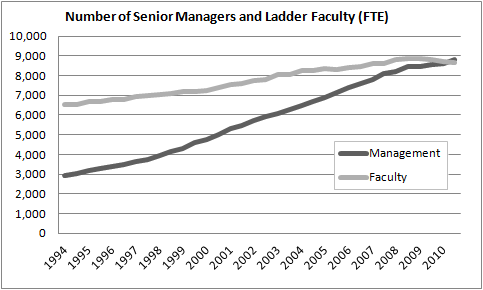
That's because thanks to budget cuts and hiring freezes, and according to UCOP's own data, the faculty decreased by 2.3% since 2009, but the number of senior management FTE's increased by 4.2% in the same period (student enrollment also increased by 3.6% in the same period, and while the increased student-faculty ratio is problematic, the fact that more students are attending UC is, in itself, is a good thing).
20 September 2011
No clue
It looks like nobody really has any clue as to how to go about addressing the University's financial problems. As widely reported, UCOP came up with a scheme whereby tuition would rise by 16% a year for the next four years (which compounds to 81%) unless the State steps in with yearly funding increases of 8% for the next four years. As anybody can imagine, this is not likely to engender warm and fuzzy feelings towards UC in those that are left as UC's only constituency and potential supporters, viz. the students and their families. Supposedly preoccupied by the fall-out, the Regents have swiftly acted with typical Regental drive and determination – and formed a commission with the task of exploring private donations as a source of external funding. The idea behind such a bold undertaking is that UC has traditionally contributed to the economic successes of California by supplying a steady stream of skilled and educated labor. California business ought to be willing to contribute to the University's bottom line in order to secure such a competitive advantage in the future as well. What this line of thought seems to have missed, though, is that there does not appear to be any reason why big business would be willing to pay in California for resources it can get for free in Mumbai – testifying yet again to the wisdom of Clark Kerr's vision characterizing a public supported education as "bait to be dangled in front of industry, with drawing power greater than low taxes or cheap labor." Perhaps even more disheartening is the fact that in all this the faculty and their official representation, the Senate, is mostly notable for their silence.
14 September 2011
UC Disorientation Guide
Reclaim UC carries a "disorientation Guide" for students entering UC this fall:
As you go from class to overcrowded class this fall, you’ll want to forget that tuition last year was around $1,800 less than you’re paying now. Continuing a 30-year trend, the UC Board of Regents gathered in cigar and gin-soaked boardrooms over the summer to raise our tuition by 17.6% and lay down plans for further increases in January, or maybe just raise tuition 81% over the next 4 years.Read the rest of it, here.
[...]
The UC Office of the President (UCOP) never tires of reminding us that tuition increases are the recession’s fault or scolding us that Californians are just unwilling to spend on education in hard times; this is a strange excuse though, since state funding has been decreasing while tuition has been skyrocketing since the early 1990s. [...] As it happens, in 9 of the past 10 years tuition was raised – well before the 2008 recession began; UCOP’s insistence on the necessity of this recent series of tuition increases has so many logical fallacies that if it were an assignment, it’d get an F (assuming, of course, that the overburdened TA grading it even had time to pay attention to it). Tuition hikes and budget cuts – at all levels of California higher education – are part of the decades-long process whereby the richest assholes in California (and the greater US) intend to make private what few institutions remain in public hands.
Even if you slept through math in high school, UC tuition increases aren’t difficult to calculate – just add a few zeros every few decades: since 1975 tuition has gone up 1,923% or, if you’d prefer to adjust for inflation, 392% (from $700 to over $12,000 per year)! Minimum wage in California, by contrast, when adjusted for inflation, has stayed roughly the same for the last 40 years, while the median family income has continued to fall since 1973. Most people in California make less money today, yet pay much more for education: for families struggling to pay rent, mortgages, car payments, etc., education becomes a luxury good. To make matters worse, financial aid packages meant to help low to middle income students attend the UC, heavily depend on students working part-time in an economy with a staggeringly high unemployment rate and very low entry- level wages; furthermore, it relies on students taking out thousands in loans that, most economic experts agree, will lock us into debt for the rest of our lives. Indeed, many economists believe that student loans will be the next credit bubble to burst, perhaps wreaking more destruction than the recession of 2008. Because there aren’t enough jobs for everyone who graduates, student loan default rates are nearing 10% – but, unlike other loans there’s no way out for student borrowers. Sallie Mae and Bank of America can take your paychecks and your children’s paychecks until they get back all their Benjamins, and then some.
08 September 2011
Brown Kerr
That's Pat Brown and Clark Kerr, the architects of California's Master Plan now in tatters. The Economist has a piece on the "quasi-privatization" of California's public universities, quoting Kerr's point that universities are "bait to be dangled in front of industry, with drawing power greater than low taxes or cheap labour." According to The Economist, this privatization strategy (higher tuition and more out-of-state students)
retains pockets of excellence. But it also runs counter to the philosophy of the master plan, by pricing ever more Californian families out of a place. The state now ranks 41st in the number of college degrees awarded for every 100 of its high school graduates.Jerry's undoing Pat's work. Isn't there a Greek tragedy about that, or something?
26 August 2011
The power of ten
Ever since the beginning of this blog, we predicted that the steady de-funding of UC by the State, accelerated by the financial crisis, would have resulted in a serious strain on the system as a whole, and provided an incentive to follow the Michigan/Virginia model for those campuses that can (UCB and UCLA, essentially), while the remaining campuses would be left to fend for themselves.
Well, Cal has just announced that in spite of the most recent cuts, they are doing quite well, thank you, mostly because of the influx of out-of-state students (about one in three freshmen) and other "efficiencies" realized by following the prescriptions of the Bain report (the laying off of about 150 staff at Cal — it's easy to realize "efficiencies" this way, it's a lot harder to save money by allowing people to work to their fullest potential).
In the meantime, UCOP has announced a program that would provide $140M to give non-represented staff and faculty a 3% pay raise. While the raise will be applied across the board, the the faculty component would only be available to faculty earning less than $200,000 a year (the vast majority of non-medical faculty) and it would be left to Chancellors to determine how best to apportion it for the purposes of "recruitment and retention." (The newly released report on 2010 compensation confirms that UC faculty salaries lag 12.8% behind those at comparable institutions.)
The proposal has generated a fair amount of criticism among the general public (Bruce Maiman is an example). Such criticism might be justified if UC still were the kind of public institution of higher learning that the State envisaged (and paid for) in the Master Plan. But in fact California has long ago decided that they are no longer willing to support an affordable, high-quality teaching and research institution open to all qualified Californians. The percentage of the UC budget paid for by the State has been shrinking for decades, and we are the point where only a fraction is taxpayers' money. A similar announcement by Stanford would not even make the news — it's not public money. And, for better or for worse, this move by UCOP is also in large part financed through tuition money, just like it would be at a private institution.
Of course, the morality of raising tuition on the students to pay for faculty pay raises is questionable (retention of quality faculty at UC is in some sense a "public good" in that it benefits California in numerous ways). But California can't have it both ways: accept (or promote) de-funding the university while at the same time complaining about the way UC makes use of the money.
Well, Cal has just announced that in spite of the most recent cuts, they are doing quite well, thank you, mostly because of the influx of out-of-state students (about one in three freshmen) and other "efficiencies" realized by following the prescriptions of the Bain report (the laying off of about 150 staff at Cal — it's easy to realize "efficiencies" this way, it's a lot harder to save money by allowing people to work to their fullest potential).
In the meantime, UCOP has announced a program that would provide $140M to give non-represented staff and faculty a 3% pay raise. While the raise will be applied across the board, the the faculty component would only be available to faculty earning less than $200,000 a year (the vast majority of non-medical faculty) and it would be left to Chancellors to determine how best to apportion it for the purposes of "recruitment and retention." (The newly released report on 2010 compensation confirms that UC faculty salaries lag 12.8% behind those at comparable institutions.)
The proposal has generated a fair amount of criticism among the general public (Bruce Maiman is an example). Such criticism might be justified if UC still were the kind of public institution of higher learning that the State envisaged (and paid for) in the Master Plan. But in fact California has long ago decided that they are no longer willing to support an affordable, high-quality teaching and research institution open to all qualified Californians. The percentage of the UC budget paid for by the State has been shrinking for decades, and we are the point where only a fraction is taxpayers' money. A similar announcement by Stanford would not even make the news — it's not public money. And, for better or for worse, this move by UCOP is also in large part financed through tuition money, just like it would be at a private institution.
Of course, the morality of raising tuition on the students to pay for faculty pay raises is questionable (retention of quality faculty at UC is in some sense a "public good" in that it benefits California in numerous ways). But California can't have it both ways: accept (or promote) de-funding the university while at the same time complaining about the way UC makes use of the money.
28 June 2011
Six hundred and fifty
That's the size of the cut (in millions) that UC is being required to take with the Governor's new budget, with possibly another $100 million if the optimistic revenue projections built into the budget do not materialize. (CSU and CCs will also get similar reductions – the Governor's budget includes almost 12 billions in cuts to services.)
Having averted the worst-case scenario (a total reduction of $1 billion to UC), there is a temptation to sit back and enjoy the summer. But in fact (unless I am mistaken, I didn't check) $650 million is the largest cut the University has been required to take in a long time. Did Arnold ever do anything remotely approaching this?
Of course the Regents have announced that any reductions above the $500 million in the January budget will come from tuition increases. So the UC faculty can sit back, take it in stride, tell each other there is nothing they can do, and that this, too, will pass.
Having averted the worst-case scenario (a total reduction of $1 billion to UC), there is a temptation to sit back and enjoy the summer. But in fact (unless I am mistaken, I didn't check) $650 million is the largest cut the University has been required to take in a long time. Did Arnold ever do anything remotely approaching this?
Of course the Regents have announced that any reductions above the $500 million in the January budget will come from tuition increases. So the UC faculty can sit back, take it in stride, tell each other there is nothing they can do, and that this, too, will pass.
10 May 2011
The ides of May
Governor Brown will release his revised budget on Monday the 16th, just after the Ides of May (May is one of those months — including March — when the Ides fall on the 15th as opposed to the 13th). That is when we'll know if the University will bear the full brunt of the "all-cuts" budget, i.e., $1 billion, or whether it will be cut "only" $500 million. It's a sad testimony to the state of UC that we are all sitting here hoping for a $500 million cut.
Some have surmised that the Governor is pursuing a "reverse Norquist." The Norquist doctrine contemplates implementing popular tax cuts in order to shrink the government, to the point where you can "drown it in the bathtub." A reverse Norquist, supposedly, pursues ruthless cuts to build up support for necessary tax collection. Both doctrines are, of course, flawed. The Norquist doctrine ignores that big corporations and the financial oligarchy have way too much to gain from their control of our supposedly democratic government to actually want to drown in the bathtub. It will never happen. Government might well get meaner towards the poor and the middle class, but it's way too useful to the oligarchy to disappear. And Brown's supposed reverse Norquist presupposes that people still value the services they are receiving — including the affordable quality education traditionally provided at UC. But California is no longer willing to pay for it. UC is not necessary for the upbringing of our very own jeunesse dorée (never was), and it no longer affords the middle class the means for upwards mobility, simply because social mobility increasingly works only one way in this country, i.e., down. So there you have it.
Some have surmised that the Governor is pursuing a "reverse Norquist." The Norquist doctrine contemplates implementing popular tax cuts in order to shrink the government, to the point where you can "drown it in the bathtub." A reverse Norquist, supposedly, pursues ruthless cuts to build up support for necessary tax collection. Both doctrines are, of course, flawed. The Norquist doctrine ignores that big corporations and the financial oligarchy have way too much to gain from their control of our supposedly democratic government to actually want to drown in the bathtub. It will never happen. Government might well get meaner towards the poor and the middle class, but it's way too useful to the oligarchy to disappear. And Brown's supposed reverse Norquist presupposes that people still value the services they are receiving — including the affordable quality education traditionally provided at UC. But California is no longer willing to pay for it. UC is not necessary for the upbringing of our very own jeunesse dorée (never was), and it no longer affords the middle class the means for upwards mobility, simply because social mobility increasingly works only one way in this country, i.e., down. So there you have it.
29 March 2011
California Budget Shenanigans
Budget negotiations broke down between Gov. Brown and the Republican minority in the Legislature. So there won't be any tax extensions on the June ballot, which means we should brace for further cuts. If you thought $500M was devastating for the university, this is probably the nail in the coffin of higher education in California.
22 March 2011
Last one out.
If you are not following the discussion over at Remaking the University on the presentation by Patrick Lenz and Nathan Bostrom to the Regents, well — you should. It seems that for once the Regents got the unvarnished truth about the financial state of the University (although see Bob Samuels' letter to the Regents for a different take).
Here is the bottom line: assuming only 1% year-over-year revenue increases from enrollment growth, 2015-16 revenue for UC will be around $5 billion, but costs will be around $7.5 billion in 2015-16, giving a gap of $2.5 billion (and that's optimistic: assumes tax extensions will be on the ballot and approved by the voters, limited increases in utility costs, etc). A number of measures can be implemented to reduce the deficit: the mythical $500 million in administrative efficiencies, better indirect cost recovery from funding agencies, tuition increases at the professional schools, more out-of-state students. Such savings and revenue increases are projected to add to about $1 billion.
So, how does the University go about closing the remaining $1.5 billion gap projected for 2015-16? There are only two sources of revenue left: state funding and student tuition. State funding would have to increase by 12.4% a year over the next four to five years to close the gap, or tuition would have to rise 18.3% each of those years. Or you could mix-and-match, with, say, 5% increases in state funding and 12.6% tuition increases. 18.3% tuition increases over 4 years, as pointed out by Bostrom in response to a question form a student Regent, compound to 95.85% — double the current levels.
It's clear that the University is out of options. Even the most draconian measures would only go a small part of the way towards filling the $1.5 billion gap:
Lenz and Bostrom pointed out that cuts are being "disproportionately" taken at the administrative level on the campuses. That might well be true. But looks like we are well past the point were significant economies can be achieved this way (much less the mythical $500 million). As much as we would like to see extravagant administrative salaries cut to size, the truth is that there is not much money there altogether. And in fact the cuts are pouring all over the place: more than 4,400 people have already been laid off (with more coming) and 3,700 vacant positions have gone unfilled. And my own department's instructional budget, used to support the graduate students with teaching assistantships and readerships, was just cut 25%. We are at the point were the mission of the University is being seriously jeopardized. And did I mention that the budget of Corrections & Rehabilitation is not being cut, and that the oil severance tax has disappeared from the horizon?
So things are definitely not well at UC. The last one out, please turn the lights off.
Here is the bottom line: assuming only 1% year-over-year revenue increases from enrollment growth, 2015-16 revenue for UC will be around $5 billion, but costs will be around $7.5 billion in 2015-16, giving a gap of $2.5 billion (and that's optimistic: assumes tax extensions will be on the ballot and approved by the voters, limited increases in utility costs, etc). A number of measures can be implemented to reduce the deficit: the mythical $500 million in administrative efficiencies, better indirect cost recovery from funding agencies, tuition increases at the professional schools, more out-of-state students. Such savings and revenue increases are projected to add to about $1 billion.
So, how does the University go about closing the remaining $1.5 billion gap projected for 2015-16? There are only two sources of revenue left: state funding and student tuition. State funding would have to increase by 12.4% a year over the next four to five years to close the gap, or tuition would have to rise 18.3% each of those years. Or you could mix-and-match, with, say, 5% increases in state funding and 12.6% tuition increases. 18.3% tuition increases over 4 years, as pointed out by Bostrom in response to a question form a student Regent, compound to 95.85% — double the current levels.
It's clear that the University is out of options. Even the most draconian measures would only go a small part of the way towards filling the $1.5 billion gap:
- Increasing the student-faculty ration from 21.1 to 1 to 22.9 to 1 (a 9.1% increase) would save about $100 million. Do it 15 times, and you've closed the gap.
- Replacing 1,100 tenure-track faculty position by non-tenure track faculty, would also save about $100 million in salary and benefits. Therefore, replacing 16,500 TT faculty by lecturers would close the gap.
- Eliminating 1,280 staff positions would also save $100 million. You get the picture.
Lenz and Bostrom pointed out that cuts are being "disproportionately" taken at the administrative level on the campuses. That might well be true. But looks like we are well past the point were significant economies can be achieved this way (much less the mythical $500 million). As much as we would like to see extravagant administrative salaries cut to size, the truth is that there is not much money there altogether. And in fact the cuts are pouring all over the place: more than 4,400 people have already been laid off (with more coming) and 3,700 vacant positions have gone unfilled. And my own department's instructional budget, used to support the graduate students with teaching assistantships and readerships, was just cut 25%. We are at the point were the mission of the University is being seriously jeopardized. And did I mention that the budget of Corrections & Rehabilitation is not being cut, and that the oil severance tax has disappeared from the horizon?
So things are definitely not well at UC. The last one out, please turn the lights off.
20 February 2011
The New Budgeting Model
A specter is haunting UC campuses – the specter of a New Budgeting Model. References to this new budgeting model, aka the "Funding Streams" proposal are being repeatedly heard in administrative office. The new budgeting model is inspired by the single principle:
Is the principle to be implemented "all the way down"? What if the internal allocation of resources on each campus were also based on a "pay-as-you-go" principle?
Revenue includes student tuition. This means that the high-enrollment classes taught by humanities and social sciences department would finally be recognized as a source of revenue, and those departments would get their fair share (and the accompanying recognition). It's been variously argued that high-enrollment classes subsidize other parts of the university offsetting losses incurred elsewhere – through the ridiculously low indirect cost rates, for instance. This kind of cross-subsidy would now come to an end, or at least come to be closely monitored.
Revenue includes profits from the medical enterprises. Nothing new here. The MCs have long held on to the million in profits they generate. While everybody recognizes that the MCs provide a crucial service to the people of California, it's not clear what the University as a whole gets from them. Berkeley seems to be doing just fine without one. The MCs are quick to call on the central campuses, e.g., to help them build a new hospital (UCIMC comes to mind), but not as quick in sharing resources in time of need. The new budgeting model would just formalize the status quo ante.
Revenue includes contracts and grants. This is a crucial aspect of the proposed model. It seems the University has finally come to recognize that it actually loses money on most grants, as the negotiated IC rates fail to cover the cost of administering those grants (President Yudof's recent statement to the Legislature said as much). This is has of course long been a bone of contention. PIs resent these indirect costs tout-court, in that they detract from the funds they have available for their research. At the same time, indirect costs cover such things as administration, building use, maintenance, etc. This at least in theory, for a in shell game a big chunk of these costs are skimmed off by UCOP and central campus administration (to be used God knows how), in return for general infrastructural support for sponsored research. The new budgeting model would seem to short-circuit the shell game. The units that generate revenue from sponsored research would keep the overhead and use it to cover indirect costs. Supposedly this would include paying "rent" to the central campus for building use etc. The big question is whether they would come up short. I don't think anybody knows. Grants lose money for the university right now. But it is possible that if all infrastructural support is done "in house" these costs might be lower. (Of course, the University also needs to negotiate higher rates with the funding agencies – but that is a long story.) In any case, it would seem that the potential losers, if there are any, in the new budgeting model might be the hard sciences, who live on high-overhead grants.
It is of course painfully clear that an implicit premise of the model is that the University needs to improve its accounting to the point where internal cash flows become apparent and can be adequately tracked. This kind of transparency is long overdue, and occasionally resisted higher up the administrative ladder (I am sure UCOP likes to have enough play money from indirect cost recovery to pay those stellar administrative salaries). This is a tall order, and the University has not been traditionally good at it. So we'll see.
Another foreseeable consequence of the model is that departments in the humanities and the social sciences will go after higher enrollments, and possibly higher enrollments of out-of-state students (with what success, it remains to be seen). New programs will be proposed, in response to real or perceived demand – new majors, minors, concentrations, MA programs (whether "fully employed" or otherwise). It's going to be a race, let's just hope it's not going to be a race to the bottom.
Finally, there is some question as to how fine-grained the individuation of "units" is going to be. This is going to be crucial, of course, if the "units" are those that keep the money. Is the allocation going to be at the level of divisions, schools, departments, research groups – or perhaps individual faculty members?
If anything like this comes to pass, it will change the way the University works. Whether in a good or a bad way, it remains to be seen.
Revenue stays with the units that generate it.This applies primarily at the campus level. The idea is that campus are going to retain the revenue they generate, and UCOP is going to assess a "tax" using the same rate across the board, to pay for centralized operations as well as for programs such as EAP, UCDC, etc. There would be only few exception to this rule – the most notable of which is financial aid. The campuses would be directed to allocate a certain amount of tuition to students' financial aid. Now, for historical reasons, some campuses get more than their fair share of this money (especially tuition), and other less. When these inequalities are addressed, there will be some winners and some losers. It will be interesting to see who is who.
Is the principle to be implemented "all the way down"? What if the internal allocation of resources on each campus were also based on a "pay-as-you-go" principle?
Revenue includes student tuition. This means that the high-enrollment classes taught by humanities and social sciences department would finally be recognized as a source of revenue, and those departments would get their fair share (and the accompanying recognition). It's been variously argued that high-enrollment classes subsidize other parts of the university offsetting losses incurred elsewhere – through the ridiculously low indirect cost rates, for instance. This kind of cross-subsidy would now come to an end, or at least come to be closely monitored.
Revenue includes profits from the medical enterprises. Nothing new here. The MCs have long held on to the million in profits they generate. While everybody recognizes that the MCs provide a crucial service to the people of California, it's not clear what the University as a whole gets from them. Berkeley seems to be doing just fine without one. The MCs are quick to call on the central campuses, e.g., to help them build a new hospital (UCIMC comes to mind), but not as quick in sharing resources in time of need. The new budgeting model would just formalize the status quo ante.
Revenue includes contracts and grants. This is a crucial aspect of the proposed model. It seems the University has finally come to recognize that it actually loses money on most grants, as the negotiated IC rates fail to cover the cost of administering those grants (President Yudof's recent statement to the Legislature said as much). This is has of course long been a bone of contention. PIs resent these indirect costs tout-court, in that they detract from the funds they have available for their research. At the same time, indirect costs cover such things as administration, building use, maintenance, etc. This at least in theory, for a in shell game a big chunk of these costs are skimmed off by UCOP and central campus administration (to be used God knows how), in return for general infrastructural support for sponsored research. The new budgeting model would seem to short-circuit the shell game. The units that generate revenue from sponsored research would keep the overhead and use it to cover indirect costs. Supposedly this would include paying "rent" to the central campus for building use etc. The big question is whether they would come up short. I don't think anybody knows. Grants lose money for the university right now. But it is possible that if all infrastructural support is done "in house" these costs might be lower. (Of course, the University also needs to negotiate higher rates with the funding agencies – but that is a long story.) In any case, it would seem that the potential losers, if there are any, in the new budgeting model might be the hard sciences, who live on high-overhead grants.
It is of course painfully clear that an implicit premise of the model is that the University needs to improve its accounting to the point where internal cash flows become apparent and can be adequately tracked. This kind of transparency is long overdue, and occasionally resisted higher up the administrative ladder (I am sure UCOP likes to have enough play money from indirect cost recovery to pay those stellar administrative salaries). This is a tall order, and the University has not been traditionally good at it. So we'll see.
Another foreseeable consequence of the model is that departments in the humanities and the social sciences will go after higher enrollments, and possibly higher enrollments of out-of-state students (with what success, it remains to be seen). New programs will be proposed, in response to real or perceived demand – new majors, minors, concentrations, MA programs (whether "fully employed" or otherwise). It's going to be a race, let's just hope it's not going to be a race to the bottom.
Finally, there is some question as to how fine-grained the individuation of "units" is going to be. This is going to be crucial, of course, if the "units" are those that keep the money. Is the allocation going to be at the level of divisions, schools, departments, research groups – or perhaps individual faculty members?
If anything like this comes to pass, it will change the way the University works. Whether in a good or a bad way, it remains to be seen.
10 February 2011
Charlie Schwartz and the Mystery of the Disappearing Billions
Prof. Charlie Schwartz, who should receive a medal for his tireless digging into UC's financial statements, has uncovered a discrepancy between the Regents' Budget (which includes general fund moneys etc.) and UC's actual expenditures. The discrepancies amount to several hundred million dollars a year, or 4-to-5 billions over the last decade.
Schwartz's repeated inquiries at UCOP (sent to Patrick Lenz, UC’s Vice President for Budget, Peter Taylor, Executive Vice President for Finance ,as well as President Yudof) have so far gone unanswered.
While the discrepancy might well, in the end, be the result of mismatched accounting definitions, it's remarkable that UC finanaces are so byzantine that not even UCOP's top brass can make sense of them.
Unless, of course, something untoward is going on. Having been raised Catholic, the California Professor knows that to think ill of someone is a sin, but more likely than not to be right on the mark.
Schwartz's repeated inquiries at UCOP (sent to Patrick Lenz, UC’s Vice President for Budget, Peter Taylor, Executive Vice President for Finance ,as well as President Yudof) have so far gone unanswered.
While the discrepancy might well, in the end, be the result of mismatched accounting definitions, it's remarkable that UC finanaces are so byzantine that not even UCOP's top brass can make sense of them.
Unless, of course, something untoward is going on. Having been raised Catholic, the California Professor knows that to think ill of someone is a sin, but more likely than not to be right on the mark.
07 February 2011
UCB Dropping ballast
We have predicted since the very early days of this blog that the de-funding of UC by the state would bring to the surface tensions and potential conflicts among the ten campuses, potentially undermining the system as a whole. The two flagships, UCB and UCLA, and aspiring falgship UCSD would look to insulate themselves from the effects of the cuts by staking a claim to academic excellence in the system.
Sure enough, it looks like Berkeley is looking to drop ballast in the face of a proposed $80M budget cut. As reported by both the California Watch and the UCLA FA blog: in the words of UCB Provost Breslauer,
UCB's attitude is nothing new or unexpected. It is also nothing inherently reproachable: UCB has to do whatever they think it is necessary for self-preservation (and so do the other campuses). One just wishes they would go about it in a slightly more diplomatic manner, paying at least lip service to the idea of one university and the "power of ten" rhetoric. You know, just so that the other nine campuses do not feel like they are being dropped as so much ballast.
Sure enough, it looks like Berkeley is looking to drop ballast in the face of a proposed $80M budget cut. As reported by both the California Watch and the UCLA FA blog: in the words of UCB Provost Breslauer,
My greatest fear is that Berkeley will be driven into lesser and lesser stature and excellence to shore up the existence of other campuses [...] We are constantly fighting to make sure that redistribution (of funds generated by the campus) does not threaten our stature, the standard by which public higher education is judged in the world.The $80M cut represents about 22.5% of UCB's $1.8 billion budget (UCB's share of state funds also declined from $500M in 2005 to a projected $225M with the new cuts), and 16% of Jerry Brown's $500M cut to UC — but notice also that 16% of undergraduates in the system are at Berkeley (35,300 out of 218,000).
UCB's attitude is nothing new or unexpected. It is also nothing inherently reproachable: UCB has to do whatever they think it is necessary for self-preservation (and so do the other campuses). One just wishes they would go about it in a slightly more diplomatic manner, paying at least lip service to the idea of one university and the "power of ten" rhetoric. You know, just so that the other nine campuses do not feel like they are being dropped as so much ballast.
20 January 2011
The Regents and the future of UC
The Regents are meeting today in San Diego, to hear a gloomy report from UCOP concerning the budget. People are talking about massive layoffs and a "shrinking university". Let's hope that they set out to do this in some remotely intelligent way: cutting across the board, as we have already said, is the absolutely stupid way to cut.
I am also amazed that people are taking these cuts in stride, including people who howled at Schwarzenegger's budgets. This is far worse than anything Arnold ever tried. And just because he's a Democrat and dated Linda Ronstadt does not mean Jerry Brown gets a pass.
I am also amazed that people are taking these cuts in stride, including people who howled at Schwarzenegger's budgets. This is far worse than anything Arnold ever tried. And just because he's a Democrat and dated Linda Ronstadt does not mean Jerry Brown gets a pass.
14 January 2011
1.4 billion
That's the total amount that the Governor's proposed budget cuts from higher education in California: $500M each from UC and CSU, and $400M from the community colleges.
That is also the amount of restored funding for the Department of Corrections and Rehabilitation, a fact that reveals much about the Governor's priorities.
The State of California might not be able afford to take care of these kids by providing affordable, quality education at a public university; but it sure can afford to take care of them later, as they enter the Corrections system.
That is also the amount of restored funding for the Department of Corrections and Rehabilitation, a fact that reveals much about the Governor's priorities.
The State of California might not be able afford to take care of these kids by providing affordable, quality education at a public university; but it sure can afford to take care of them later, as they enter the Corrections system.
Subscribe to:
Posts (Atom)